Homepage

Recovery and Construction
The team designs and implements solutions for restoring critical infrastructure and housing stock, reconstructing buildings and structures, and modernizing tracks and bridges. A key focus is recycling construction materials after destruction and creating new structures from secondary raw materials.
These technologies underpin the VIDNOVA project for Ukraine’s reconstruction, initiated by the Algorithm Group co-founder together with international partners, in which we take an active part.


After large-scale destruction, Ukraine is simultaneously rebuilding and moving toward EU integration. In this context, new construction approaches are crucial—focusing on material recycling, waste reduction, and resource reuse.
This approach ensures cost efficiency, environmental responsibility, and process sustainability.
Reconstruction during and after the war
We implement technologies that reduce construction time and cost severalfold by using recycled materials. Recycling shapes a new recovery model—cost-effective, eco-friendly, and resilient to post-war challenges.

EU Path and Euro Standards
Transitioning to European standards requires both EN compliance and adoption of circular economy principles. We combine engineering, testing, and certification with a resource-aware environmental approach to secure swift approvals and full EU compliance.

Demand for engineering from Ukraine
EU countries face an engineering shortage, especially in sustainable construction and infrastructure recovery. Our teams cover competencies from diagnostics and modeling to recycling technologies, creating collaboration opportunities and integrating Ukrainian engineering into the European recovery market.



inspections of buildings and structures by certified experts, followed by serviceability assessments;



development of solutions to restore lost load-bearing capacity and strengthen structures;



preparation and approval of design documentation for construction or restoration, and subsequent technical reports based on inspections;



sorting and recycling of construction waste to obtain clean secondary raw materials;



testing of structures and materials in accredited laboratories for compliance with codes and design requirements;



design of repair and reconstruction solutions using innovative materials and structural systems;



development of 3D-printing technologies for concrete structures, including mix design and print parameters;



application of BIM modeling in construction and asset management.



development of rail fastenings for railway infrastructure modernization, including high-speed lines;



implementation of concrete sleepers with composite reinforcement for electrified railway sections;



use of deck underlay materials for bridges with enhanced durability.


The outcome is a technology that has passed expert review and testing and is ready for industrial deployment.

We combine UkrSURT’s scientific rigor, the Algorithm Group’s hands-on implementation experience, and international partners’ expertise—focused on sustainability and material recycling.

Scientific school & team
The projects involve scientists from specialized departments — experts in concrete and reinforced concrete, diagnostics, and modeling. The team has experience in structural inspections, laboratory testing, and design using recycled materials.

Engineering co-founder companies
The Algorithm Group makes this direction one of its key areas thanks to years of expertise in construction materials recycling, innovative structural design, construction, and implementation of European standards.

International partners
Cooperation with Vollert Anlagenbau, IAB Weimar, and CDE Group strengthens our expertise in precast reinforced concrete, applied research, and material recycling. We operate under European procedures, facilitating entry into EU markets.
Practical implementations
The team implements infrastructure solutions for public authorities and businesses — from inspections and design documentation to pilot project launches. Science Park specialists integrate recycling technologies within the VIDNOVA initiative and EU-funded projects.
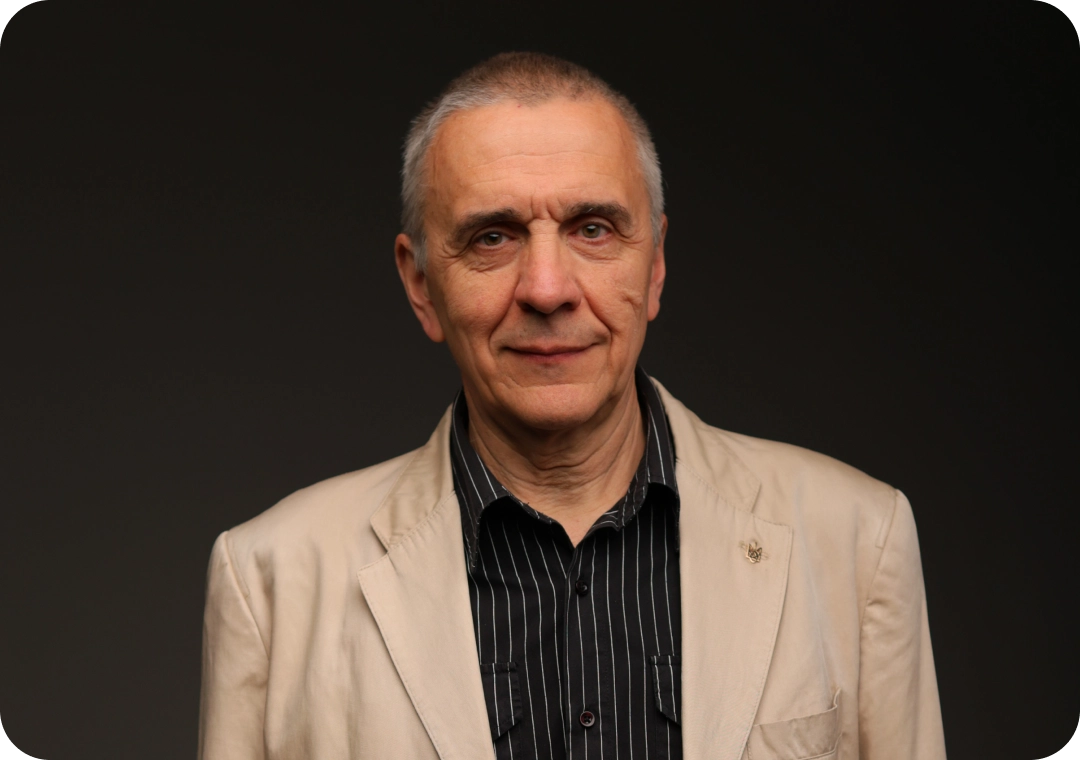
Andrii Pluhin
Doctor of Technical Sciences, Professor, Head of Department, Head of “Recovery and Construction” direction

Dmytro Pluhin
Doctor of Technical Sciences, Professor, Head of the Department of Building Materials, Structures and Facilities

Oleksii Lobiak
PhD in Technical Sciences, Associate Professor, Head of the Department of Structural Mechanics and Hydraulics

Liudmyla Trykoz
Doctor of Technical Sciences, Professor, Department of Building Materials, Structures and Facilities

Olha Borziak
Doctor of Technical Sciences, Associate Professor, Department of Building Materials, Structures and Facilities
Serhii Miroshnychenko
PhD in Technical Sciences, Associate Professor, Department of Building Materials, Structures and Facilities
Oleh Kalinin
PhD in Technical Sciences, Associate Professor, Department of Building Materials, Structures and Facilities

Oleksandr Romanenko
PhD in Technical Sciences, Associate Professor, Department of Building Materials, Structures and Facilities

Oleh Herasymenko
PhD in Technical Sciences, Associate Professor, Department of Building Materials, Structures and Facilities

Volodymyr Stefanov
PhD in Technical Sciences, Associate Professor, Department of Mechanical Engineering and Machine Service

Yevhenii Romanovych
PhD in Technical Sciences, Associate Professor, Department of Mechanical Engineering and Machine Service
ACADEMTEST Laboratory for Testing Materials and Structures
The laboratory is accredited by the National Accreditation Agency of Ukraine and operates in accordance with international standards, including ISO/IEC 17025. It provides objective quality verification and prepares full protocol packages.
Features
• high-precision equipment: universal testing machines, hardness testers, spectrometers, optical devices;
• many years of experience in industry, energy, transport, and the defense sector.
Services
• non-destructive testing;
• mechanical testing;
• hardness testing;
• other tests.
VIATEST Laboratory for Determining Physical and Mechanical Properties of Construction Materials

The laboratory studies materials used in the construction, repair, and maintenance of roads and engineering structures. It ensures accurate results thanks to the team’s long-term experience, modern equipment, and top-tier methodologies.
Features
• wide range of tests on road and construction materials;
• testing of transport and operational properties of roads;
• modern laboratory equipment;
• quality control during works;
• expert assessment with high precision.
Services
• analysis of soils, sand, crushed stone, and mixtures;
• testing of concrete, cement, and reinforced concrete;
• evaluation of bitumen, asphalt, and road mixtures;
• testing of road signs and marking materials;
• quality control of works and structures.
Sectoral Research Laboratory of Rail Bases and Special Reinforced Concrete
Features
• research of critical transport infrastructure facilities;
• modern measuring base and CAD/CAE modeling;
• cooperation with enterprises, ministries, and transport operators;
• participation in the development of regulatory and technical documentation for the industry.
Services
• research on the composition, properties, and technologies of concrete and reinforced concrete;
• testing of construction materials and products;
• technical inspection of structures, railways, and building constructions;
• development and review of national standards and technical specifications;
• participation in governmental and applied R&D projects;
• collaboration with certification and diagnostic centers.
Sectoral Research Laboratory of Corrosion and Corrosion Protection of Railway Structures
Features
• study of critical transport infrastructure facilities;
• modern measuring base and CAD/CAE modeling;
• cooperation with enterprises, ministries, and transport operators;
• participation in developing sectoral regulatory and technical documentation.
Services
• physico-chemical studies of corrosion in materials and structures;
• analysis of material manufacturing and degradation processes;
• development and testing of corrosion protection coatings and technologies;
• technical support for railway infrastructure facilities;
• participation in developing industry regulations;
• fundamental and applied R&D projects.
Sectoral Research Laboratory “Continuous Track”
Features
• research on critical transport infrastructure facilities;
• modern measuring base and CAD/CAE modeling;
• cooperation with enterprises, ministries, and transport operators;
• participation in developing industry regulatory documentation.
Services
• research on efficiency and implementation of continuous track;
• analysis of track–rolling stock interaction under complex conditions;
• evaluation of service life and reuse of track elements;
• improvement of track infrastructure;
• introduction of resource-saving technologies;
• development of regulatory and technical documentation;
• participation in high-speed rail implementation programs.
Sectoral Research Laboratory “Mechanization of Loading, Unloading, and Track Works in Railway Transport”
Features
• study of critical transport infrastructure facilities;
• modern measuring base and CAD/CAE modeling;
• cooperation with enterprises, ministries, and transport operators;
• participation in developing industry documentation.
Services
• development and implementation of mechanization tools for freight and track operations;
• improvement of bulk cargo handling technologies;
• creation of equipment for servicing weighing systems and shunting operations;
• introduction of new energy-saving technical solutions;
• participation in the development of national standards and regulations;
• testing and implementation of award-winning equipment.

Logistics and Transport
Development of the first-ever Network Statement in Ukraine for Ukrainian Railways as part of EU railway directive implementation.

Energy Efficiency
Energy audit and cataloging of thermal power equipment for UkrGasVydobuvannya (the largest Ukrainian gas producer) facilities.

Reconstruction and Construction
Engineering support for the construction of the agglomeration plant and gas treatment systems at the converter shop of ArcelorMittal (2015–2017).

Chemotology and Materials Science
Modernization of the pelletizing plant at the Northern Iron Ore Beneficiation Works (Metinvest), including the implementation of new equipment (2019–2020).

Logistics and Transport
Optimization of grain logistics in partnership with the University of the West of Scotland under the UK–Ukraine R&I Twinning Grant.
Let’s Connect
Thank you.
Your information has been successfully submitted, and we will contact you shortly.

© AI Science Park 2025 | All rights reserved

UA